LOADING

John Clarke and the History of the Potato
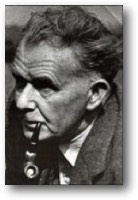
First, lets find out a little more about John Clarke himself…
From the New Ulster Biography web site:
John Clarke was born on 1 February 1899 at Lamnagh Beg, Ballintoy, on the North Antrim coast, son of Daniel and Margaret. He attended St. Mary’s Primary School at Ballinalea, but due to the need to help with the family farm in Broughgammon, he obtained no further formal education. Despite this, by dint of extensive reading in Ballymoney Library and ongoing research and experimentation throughout his life, he became a recognised expert on the science of potato breeding, producing dozens of varieties, some of which are still widely produced. John’s father was known to have tried to produce new potato varieties but it was John who pursued this activity much beyond what his father had achieved.
When John married Angela Hayes, a local schoolteacher, in 1947 the couple set up home in a farm close to the Giant’s Causeway. The farmhouse, named Innisfree and buildings are now part of the National Trust Complex at the Causeway and is the site of the Educational Centre close to the Causeway.
In 1923 Daniel and John had their potatoes certified by the Ministry of Agriculture’s Seed Classification system. John specialised in the first early varieties, harvested in June and July. His first variety Ulster Monarch was certified in 1936. Over the next 51 years he was to have 33 varieties certified, of which the first 30 had the prefix Ulster.
John was respected by his contemporaries and by specialist scientists such as Dr. R.N. Salaman and Dr. H. Howard. Dr Salaman F.R.S. was a leading expert on diseases of the potato and lived near Cambridge, running a botanical research centre. Salaman researched and promoted resistance to viruses in potatoes and set out to multiply virus-free stocks to supply outlets throughout the UK. John Clarke worked closely with Dr. Salaman in this endeavour, setting up greenhouses in Broughgammon and Innisfree.
John won many accolades. He was awarded the Lord Derby Gold Medal in 1948, a Master of Agriculture Degree by QUB in 1950, the John Snell Medal by the National Institute of Agricultural Botany, Cambridge in the mid-1950s and in 1957 the Belfast Telegraph Cup for Outstanding Achievements in Agriculture. John was awarded the OBE in 1969. He died on 28 May 1980.
John Clarke was born on 1 February 1899 at Lamnagh Beg, Ballintoy, on the North Antrim coast, son of Daniel and Margaret. He attended St. Mary’s Primary School at Ballinalea, but due to the need to help with the family farm in Broughgammon, he obtained no further formal education. Despite this, by dint of extensive reading in Ballymoney Library and ongoing research and experimentation throughout his life, he became a recognised expert on the science of potato breeding, producing dozens of varieties, some of which are still widely produced. John’s father was known to have tried to produce new potato varieties but it was John who pursued this activity much beyond what his father had achieved.
When John married Angela Hayes, a local schoolteacher, in 1947 the couple set up home in a farm close to the Giant’s Causeway. The farmhouse, named Innisfree and buildings are now part of the National Trust Complex at the Causeway and is the site of the Educational Centre close to the Causeway.
In 1923 Daniel and John had their potatoes certified by the Ministry of Agriculture’s Seed Classification system. John specialised in the first early varieties, harvested in June and July. His first variety Ulster Monarch was certified in 1936. Over the next 51 years he was to have 33 varieties certified, of which the first 30 had the prefix Ulster.
John was respected by his contemporaries and by specialist scientists such as Dr. R.N. Salaman and Dr. H. Howard. Dr Salaman F.R.S. was a leading expert on diseases of the potato and lived near Cambridge, running a botanical research centre. Salaman researched and promoted resistance to viruses in potatoes and set out to multiply virus-free stocks to supply outlets throughout the UK. John Clarke worked closely with Dr. Salaman in this endeavour, setting up greenhouses in Broughgammon and Innisfree.
John won many accolades. He was awarded the Lord Derby Gold Medal in 1948, a Master of Agriculture Degree by QUB in 1950, the John Snell Medal by the National Institute of Agricultural Botany, Cambridge in the mid-1950s and in 1957 the Belfast Telegraph Cup for Outstanding Achievements in Agriculture. John was awarded the OBE in 1969. He died on 28 May 1980.
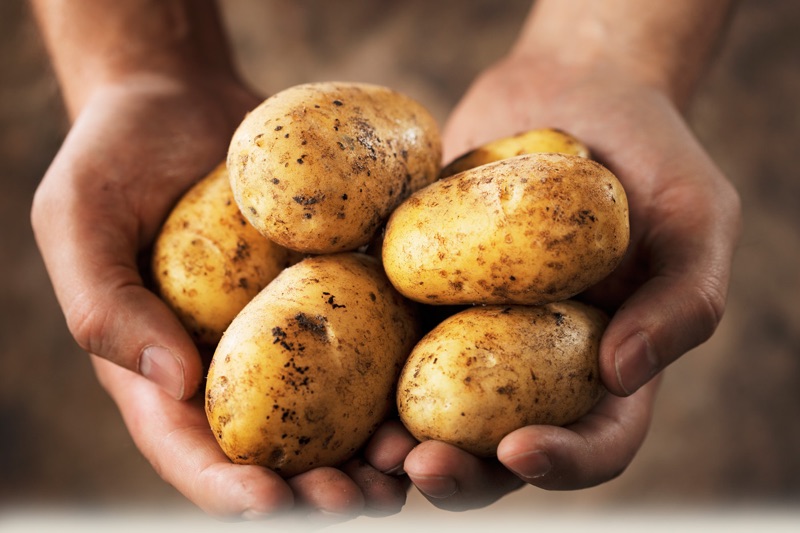
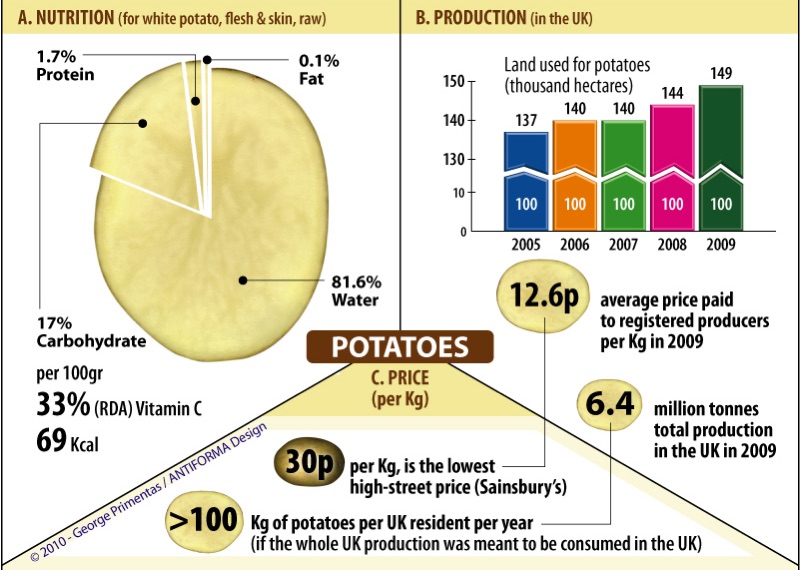
Some Potatoes and some information about Potatoes you may find surprising!
If the slide moves to fast for you to read, hover the mouse pointer over the picture to stop the changeover.

From the Ulster History Circle web site…
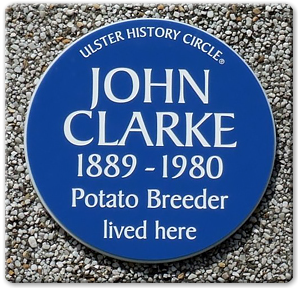
Blue plaque for John Clarke - 25 April 2013
On a beautiful sunny spring-like morning on the North Antrim Coast, with the blue Atlantic Ocean and the Hills of Donegal as a shimmering backdrop, the family and friends of John Clarke gathered at his former home and workplace to honour his life and extraordinary work.
Chris Spurr, Chairman of the Circle, welcomed everyone to this special event, which the first of several such events in memory of a very special person. This was the latest of our Ulster History Circle blue plaques and a new edition to those already in North Antrim. There is Olympic Gold Medallist Kennedy Kane McArthur in Dervock, Gugliemo Marconi in Ballycastle, Robert the Bruce in Rathlin and Viscount Macartney at Lissanoure. Chris said that when he first heard Maurice McHenry speaking on Radio Ulster about John Clarke he knew that here was a first-class subject for a blue plaque. Planning the plaque has been a fruitful collaboration with the National Trust here at the Causeway and the Circle wanted to thank the Trust for helping to fund the plaque. Max Bryant, Eleanor Killough, Art Ward and Cliff Henry all helped to make this happen. He hoped that this might lead to further projects in the future. The Circle was delighted to celebrate John Clarke with this permanent reminder of his life and achievements.
Councillor Sandra Hunter, Chair of Moyle District Council, said that it was her pleasure, on behalf of the District Council, to welcome everyone to this event in honour of John Clarke. John Clarke developed 33 varieties of potatoes, most which carried the prefix 'Ulster' and his work lives on in his most famous variety, the Maris Piper. She said that she lived close by and had taken the land beside the Centre in conacre from the National Trust. It was a privilege to be able to till the same land as that used by John Clarke. She thanked Maurice McHenry, the Ulster History Circle and the National Trust for this memorial to John Clarke.
Maurice McHenry, Clarke's biographer, said that John Clarke had worked all his life with potatoes. There is no plant more associated with Ireland, and he included the shamrock, than the potato; it has a bigger influence than any other plant in Irish history since it arrived on these shores through good times and bad times. It contributed to the rapid grown of population in the first part of the nineteenth century, and not just in Ireland but all over the world. You might ask what it had to do with John Clarke. After blight hit the potato in the 1840s people sought to find ways to overcome the disease. Very few people in Northern Ireland knew what John Clarke was doing and the extent of his achievements. Born less than 50 years after the Famine he left school at the age of 12. For most people that was a handicap they would never overcome. Clarke overcame more than that. He bred 33 varieties of potatoes from 1936. You can't write a book about potato varieties without meeting John Clarke. He worked on his own without a team around him. Others had hundreds of workers, modern technology and scientific oversight - he worked on his own, largely unknown. He was very self-effacing, never talked about himself. Maurice said that he was very grateful that John's wife Angela has kept press cuttings and preserved his correspondence. If he hadn't written the book his story would have gone untold. When the book was launched, Dr Paul Watts, the leading potato breeder in Northern Ireland, said he had not been aware of John Clarke's contribution to the potato. The largest proportion, 16%, of potato production is the Maris Piper. The Maris Piper is the grandson of one of Clarke's potatoes.
Clarke was held in very high esteem by prominent figures in the field. Starting in 1940, Dr Howard, attached to Cambridge University, visited Clarke annually for many years to discuss potato varieties. He was also held in high regard by Dr Salaman, a leading expert on the potato who was reported as saying that Clarke was his favourite student. The first place that Harry Keogh, breeder of the Rooser variety, came after setting up in Carlow, was to North Antrim and John Clarke and he always gave credit to a man who didn't sell himself but left a legacy that is not forgotten. For this reason he wished to thank the Ulster History Circle and the National Trust for this plaque.
In conclusion he said that the Ballintoy Archaeological and Historical Society are working with the National Trust to develop a Potato Centre here for young people to learn about potatoes.
Roy Bailie, Chair of NI Region, National Trust, welcomed everyone on behalf of the National Trust. He said that he lived in Castlerock and spend a lot of time on the causeway coast with his dog. When he first heard about the blue plaque he asked 'Why are they honouring my brother-in-law?" who is also called John Clarke. He has a close association with the Maris Piper and also rugby. When Ulster played Connaught he invited some neighbours to watch. His wife said he would have to feed them. As he could only cook stew he peeled a stone of Maris Pipers and the visitors cleared the lot. He invited everyone to refreshments in the Community and Learning Centre after the ceremony and also said if there were any non-members of the National Trust present they would be welcome to visit the new Visitors centre this morning free of charge.
After the plaque unveiling, there was a short illustrated presentation in the Community and Learning Centre by Art Ward of the National Trust of a new schools' potato project featuring John Clarke, and afterwards local primary school children planted potatoes in lazy beds near the centre.
Here are some photos of the event.
Councillor Sandra Hunter, Chair of Moyle District Council, said that it was her pleasure, on behalf of the District Council, to welcome everyone to this event in honour of John Clarke. John Clarke developed 33 varieties of potatoes, most which carried the prefix 'Ulster' and his work lives on in his most famous variety, the Maris Piper. She said that she lived close by and had taken the land beside the Centre in conacre from the National Trust. It was a privilege to be able to till the same land as that used by John Clarke. She thanked Maurice McHenry, the Ulster History Circle and the National Trust for this memorial to John Clarke.
Maurice McHenry, Clarke's biographer, said that John Clarke had worked all his life with potatoes. There is no plant more associated with Ireland, and he included the shamrock, than the potato; it has a bigger influence than any other plant in Irish history since it arrived on these shores through good times and bad times. It contributed to the rapid grown of population in the first part of the nineteenth century, and not just in Ireland but all over the world. You might ask what it had to do with John Clarke. After blight hit the potato in the 1840s people sought to find ways to overcome the disease. Very few people in Northern Ireland knew what John Clarke was doing and the extent of his achievements. Born less than 50 years after the Famine he left school at the age of 12. For most people that was a handicap they would never overcome. Clarke overcame more than that. He bred 33 varieties of potatoes from 1936. You can't write a book about potato varieties without meeting John Clarke. He worked on his own without a team around him. Others had hundreds of workers, modern technology and scientific oversight - he worked on his own, largely unknown. He was very self-effacing, never talked about himself. Maurice said that he was very grateful that John's wife Angela has kept press cuttings and preserved his correspondence. If he hadn't written the book his story would have gone untold. When the book was launched, Dr Paul Watts, the leading potato breeder in Northern Ireland, said he had not been aware of John Clarke's contribution to the potato. The largest proportion, 16%, of potato production is the Maris Piper. The Maris Piper is the grandson of one of Clarke's potatoes.
Clarke was held in very high esteem by prominent figures in the field. Starting in 1940, Dr Howard, attached to Cambridge University, visited Clarke annually for many years to discuss potato varieties. He was also held in high regard by Dr Salaman, a leading expert on the potato who was reported as saying that Clarke was his favourite student. The first place that Harry Keogh, breeder of the Rooser variety, came after setting up in Carlow, was to North Antrim and John Clarke and he always gave credit to a man who didn't sell himself but left a legacy that is not forgotten. For this reason he wished to thank the Ulster History Circle and the National Trust for this plaque.
In conclusion he said that the Ballintoy Archaeological and Historical Society are working with the National Trust to develop a Potato Centre here for young people to learn about potatoes.
Roy Bailie, Chair of NI Region, National Trust, welcomed everyone on behalf of the National Trust. He said that he lived in Castlerock and spend a lot of time on the causeway coast with his dog. When he first heard about the blue plaque he asked 'Why are they honouring my brother-in-law?" who is also called John Clarke. He has a close association with the Maris Piper and also rugby. When Ulster played Connaught he invited some neighbours to watch. His wife said he would have to feed them. As he could only cook stew he peeled a stone of Maris Pipers and the visitors cleared the lot. He invited everyone to refreshments in the Community and Learning Centre after the ceremony and also said if there were any non-members of the National Trust present they would be welcome to visit the new Visitors centre this morning free of charge.
After the plaque unveiling, there was a short illustrated presentation in the Community and Learning Centre by Art Ward of the National Trust of a new schools' potato project featuring John Clarke, and afterwards local primary school children planted potatoes in lazy beds near the centre.
Here are some photos of the event.
LOADING
-

Causeway home of John Clarke
-

John Clarke's daughter Miriam Hanna, centre, with his nieces Barbara (left) and Rosemary
-
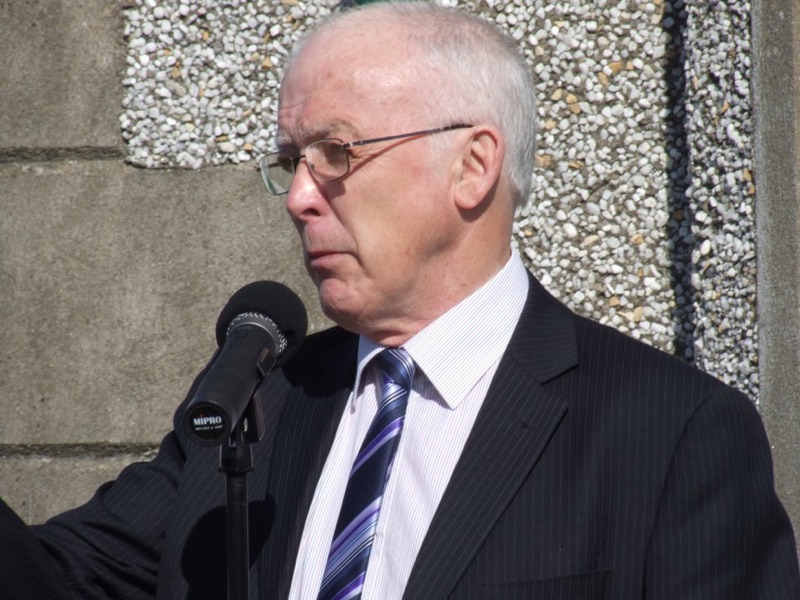
Maurice McHenry, Clarke's biographer
A review of Maurice McHenry’s biography…
Review, Farming Life, 16 September 2012
A NEW book by local historian Maurice McHenry, a founder member and chairman of Ballintoy Archaeological and Historical Society, is to be launched this coming Monday (September 17) at the recently opened Giant’s Causeway Visitor Centre.
A NEW book by local historian Maurice McHenry, a founder member and chairman of Ballintoy Archaeological and Historical Society, is to be launched this coming Monday (September 17) at the recently opened Giant’s Causeway Visitor Centre.
LOADING



John Clarke: A Potato Wizard explores the life and achievements of the pioneering North Antrim potato breeder and will be launched by Paul Watts, head of potato research at the Agri-Food and Biosciences Institute, Loughgall.
In addition, those present will hear about the National Trust’s exciting new potato project from Max Bryant and will have an opportunity to see boxty, a traditional Irish potato dish, made by Padraic Og Gallagher, the owner of Gallagher’s Boxty House, Temple Bar, Dublin.
The launch will also be attended by the leading players in the potato breeding industry, including Dr Harry Kehoe, who for many years led the Plant Breeding Station at Teagasc, Oak Park, Carlow and produced the Rooster variety, which is now the predominant potato grown in Ireland.
Mr McHenry explains: “Largely self-educated, Clarke understood the principles of the emerging science of genetics and applied them to the breeding of potatoes. “A talented botanist, Clarke developed 33 certified varieties, the vast majority of which have the prefix Ulster in their name, and was a key figure in the struggle to breed varieties which were more resistant to potato blight.
“Remarkably Clarke an independent breeder, with only modest resources and facilities at his disposal, was able to compete on, at least equal terms, with the specialist government-sponsored plant breeding institutions that were established during his lifetime.
“As well as being good scientist, Clarke had a natural flair for selecting the best seedlings.”
Clarke’s achievements earned him an international reputation as a highly successful potato breeder.
Mr McHenry says: “He was much respected by his contemporaries who worked in this field, including the influential Dr Redcliffe Nathan Salaman and Dr Harold Howard. Both Salaman and Howard travelled from England to Broughgammon, near Ballintoy, to exchange ideas and potato varieties.
“Clarke received many prestigious awards in recognition of his important contribution to the potato industry, including the Lord Derby Gold Medal in 1948, the highly prized John Snell Medal in the mid 1950s and the OBE in 1969. In return, Clarke has left us a lasting legacy – his potatoes.”
Sadly, today, the role played by John Clarke is largely unknown and there is a real danger that his achievements will be forgotten, even in his native North Antrim.
But Maurice McHenry, a well known retired head teacher and sheep farmer from Ballintoy, has, however, over the past few years led a crusade to rescue Clarke from obscurity.
This has motivated him to research and present a passionate, fitting and timely tribute to John Clarke.
Mr McHenry’s book will ensure that Clarke is remembered and celebrated. Moreover, it fills a major gap in our agricultural and scientific history.
In addition, those present will hear about the National Trust’s exciting new potato project from Max Bryant and will have an opportunity to see boxty, a traditional Irish potato dish, made by Padraic Og Gallagher, the owner of Gallagher’s Boxty House, Temple Bar, Dublin.
The launch will also be attended by the leading players in the potato breeding industry, including Dr Harry Kehoe, who for many years led the Plant Breeding Station at Teagasc, Oak Park, Carlow and produced the Rooster variety, which is now the predominant potato grown in Ireland.
Mr McHenry explains: “Largely self-educated, Clarke understood the principles of the emerging science of genetics and applied them to the breeding of potatoes. “A talented botanist, Clarke developed 33 certified varieties, the vast majority of which have the prefix Ulster in their name, and was a key figure in the struggle to breed varieties which were more resistant to potato blight.
“Remarkably Clarke an independent breeder, with only modest resources and facilities at his disposal, was able to compete on, at least equal terms, with the specialist government-sponsored plant breeding institutions that were established during his lifetime.
“As well as being good scientist, Clarke had a natural flair for selecting the best seedlings.”
Clarke’s achievements earned him an international reputation as a highly successful potato breeder.
Mr McHenry says: “He was much respected by his contemporaries who worked in this field, including the influential Dr Redcliffe Nathan Salaman and Dr Harold Howard. Both Salaman and Howard travelled from England to Broughgammon, near Ballintoy, to exchange ideas and potato varieties.
“Clarke received many prestigious awards in recognition of his important contribution to the potato industry, including the Lord Derby Gold Medal in 1948, the highly prized John Snell Medal in the mid 1950s and the OBE in 1969. In return, Clarke has left us a lasting legacy – his potatoes.”
Sadly, today, the role played by John Clarke is largely unknown and there is a real danger that his achievements will be forgotten, even in his native North Antrim.
But Maurice McHenry, a well known retired head teacher and sheep farmer from Ballintoy, has, however, over the past few years led a crusade to rescue Clarke from obscurity.
This has motivated him to research and present a passionate, fitting and timely tribute to John Clarke.
Mr McHenry’s book will ensure that Clarke is remembered and celebrated. Moreover, it fills a major gap in our agricultural and scientific history.