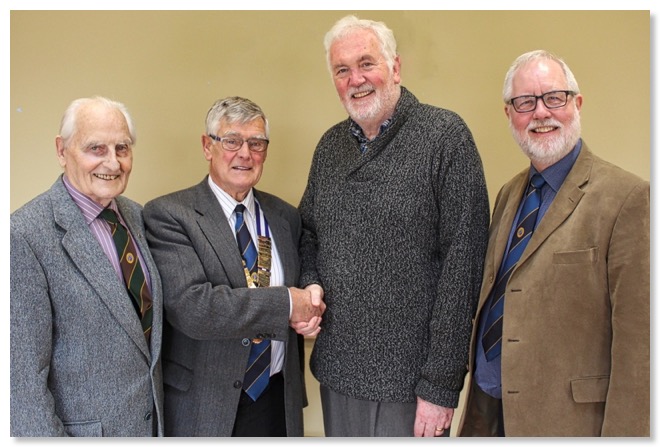
Speaker for 10th January 2017
Part 1
The President, Jim Archer, welcomed members to the meeting. He then introduced this morning’s speaker, John Moore, the topic of his talk being “The Creation of a Village - Castlerock” (John kindly stepped in as speaker when Jean Orr could not attend because of illness.)
John began by explaining that most villages grow from settlements formed around environmental or social structures, but not Castlerock. The village has its origins partly due to the building of Downhill Palace in the late 1700’s and partly thanks to the railway company 100 years later. John explained in detail the high specification development encouraged by Sir Hervey Bruce in 1866 and in 1862 by the Railway Company.
By the 1900’s the village had already started to grow with the opening of the golf club in 1901. A microcosm of the development can be experienced with a walk along Circular Road. Victorian and Edwardian houses, those built in the post war periods up to the ultra modern house opposite the golf club. Castlerock is the village that got its name from a railway station and has its origins with the descendants of the Earl Bishop.
A question and answer session followed the talk. A brief summary of this talk is also available in the speakers’ record book.
Part 2
Coleraine Probus and a look at Castlerock history
Coleraine Probus Club was pleased to welcome back guest speaker and local historian John Moore, who presented a fascinating account of 'Castlerock, the creation of a village'. John began by explaining that most villages grow from settlements formed around environmental or social structures: a natural harbour; a river crossing; a fortified area, and so on. For Castlerock, it was a very different beginning. The village has its origins partly due to the building of the Downhill palace in the late 1700s and partly thanks to the railway a hundred years later.

As historically recent as the 1830s, the ordnance survey maps show in clear detail the 1612 village of Articlave, the 1690 Hezlett House and even three fisherman huts at the Barrmouth, but no 'Castlerock'. Ten years later, the railway was slowly connecting towns in the North West. Ballymena, Ballymoney and down to Coleraine, with the Londonderry to Coleraine line working its way along the coast and tunnelling through the cliff face below the Mussenden Temple. There was still no Castlerock, although one house is shown.

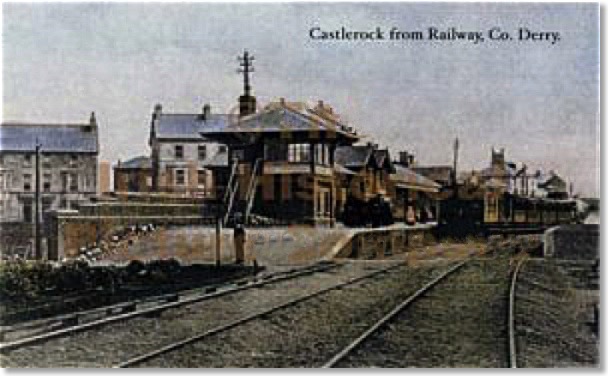
The ordnance map of 1862 shows a small station and a few cottages. This seems to have been put into the rail line for the convenience of the Hervey Bruce family, and this is named as 'Castlerock Station'. The name is thought to originate from the shipping navigation marker for craft heading up the Bann, and was a large rock formation that from the sea, looked like a castle. This is no longer visible as the sand covering on the beach is estimated to have grown by at least 10 to 12 feet in the last 100 years.
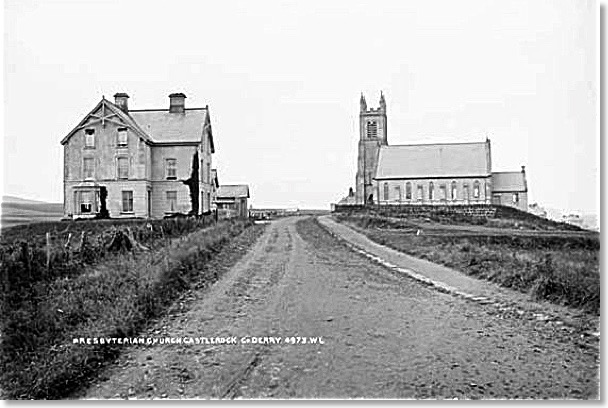
In 1866 Sir Hervey Bruce had plans drawn up for houses to be built forming a main street parallel to the railway line. To encourage the building and movement to taxpaying families into new area around the station, the railway company offered a 10 year free railway ticket (known as a 'Golden Ticket') for people travelling from Coleraine or (the better value option) from Londonderry if their destination was Castlerock Station. As the housing stock developed, so the station name came to be associated with the newly growing village.

By 1870 the Church of Ireland Parish Church 'Christ Church' was added to the new village, and some years later the Presbyterian Church was built. By the 1900s the village really started to grow. Holidays and the idea of bathing in the sea (for hardy types? - WebEd) along with sandcastles and entertaining children brought more families to Castlerock and the beach. Quite a large number of the properties were owned by families who lived elsewhere and took the train to the village for weekends and holidays or to play golf.
1901 saw the creation of the Castlerock Golf Club. This has grown and established itself as one of the finest clubs in the area. In the 1930s the Golf Hotel opened and encouraged holiday makers and golfers to the village. By the 1960s Castlerock boasted an outdoor, heated swimming pool, further enhancing its name as a first rate seaside holiday destination. But tastes and other changes have effected the village. The hotel has been demolished and the swimming pool is now a car park, but caravan holidaymakers and golfers still come to Castlerock. Thousands for National Trust visitors walk the Downhill Palace grounds and the train still brings its passengers to the village - the village that got it's name from a station, and has it's origins with the descendants of the Earl Bishop.
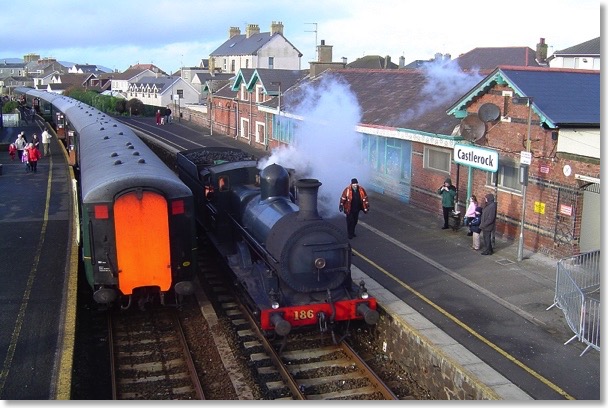
An extra 'Footnote':
FINAL CALL FOR VICTORIAN RAILWAY SIGNAL BOX IN CO DERRY
(from the 'Derry Daily', November 7, 2016)
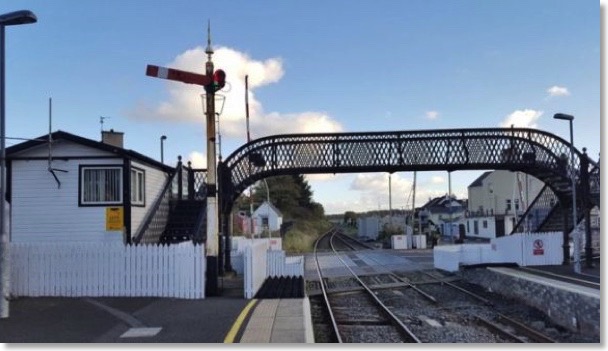
IT has been used as a signalling station for nearly 150 years. But now the last railway box in the North of Ireland has hit the buffers and is to be pulled down. Staff at Castlerock used bells, levers and mechanical frames to keep trains on track between Derry and Coleraine. Now computerised signalling technology will replace the Victorian model this week.
Once there were thousands of signal boxes at stations across the land but now the future looks very different. Kevin Brown worked in the signal box in Castlerock for more than 20 years. He said it would be a sad farewell. “It’s the end of an era and it’s going to be very emotional to go. For 20-odd years she’s been my life, she’s been my baby, my cabin,” he said. “Each lever operates a signal or a set of points and this is the exact same way it would have been done in Victorian times. “It’s very emotional because I’ve got the privilege of being the last man out to lock up. I walk away from the cabin and that’s me finished as a signaller for Castlerock.”
The station itself and a railway signal box has been in existence since 1874, although the original signal cabin was replaced in the 1970s. The Victorian buildings, including the original signal box, were designed by the famous architect John Lanyon. While the wrought iron footbridge has moved around over the years, it remains a part of the landscape. “The signal cabin’s role is to safely move trains between Derry and Coleraine. “It does that via semaphore signals, which you can see up on poles, and also via token exchange which are metal tokens handed out to trains to allow them to move into the sections,” said Richard Knox, head of network operations for NI railways. “It is very much the old school way – the gentleman in the signal cabin, through a process of levers and token machines, allows the trains to travel through the station – so he physically pulls levers. “What’s going to change is that is the major capital project to re-signal the whole line between Coleraine and Londonderry,” Mr Knox added.
The entire rail network in the north west is being modernised with new signalling and a new passing loop for trains at a cost of £46 million. Mr Brown said he accepts that times are changing and he will retire at the end of his shift on Thursday night. “I’ve had so many good times in the cabin,” he said. “One of my highlights is when I first arrived here and I started training with a very old signal man called Neville McCorkell.” “The first time I walked in here, he told me: “Son, whatever you do, no matter where you go, always treat the frame with respect. Love her, because she will kick back at ya.” “Life moves on and we’ve got to move forward and we’ve got to come into the 21st century,” Mr Brown added.