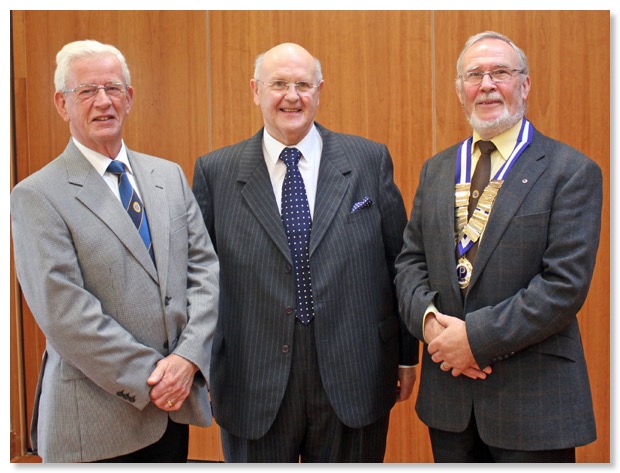
Speaker for Tuesday 1st October 2013 - Mr Robert Alcorn
Talk by Mr Robert Alcorn on ‘The work of a Resident Magistrate’
Club President Graham Kane welcomed club members and then introduced our speaker for the morning, Mr. Robert Alcorn, who gave an extremely interesting and informative talk on the work of a Resident Magistrate.
Robert began his talk with a brief resume of his career and the milestones leading to his long-standing service as a Resident Magistrate (RM). He was born and brought up in Limavady, where after qualifying, he spent 30 years as a solicitor. In 1990 he was appointed as a RM, initially in the Larne area, and in later years in the Antrim courts as District Judge (DJ). He had an undeserved 'nick-name' (in Robert's opinion anyway!) of 'Maximum Bob', as he tended to give the maximum compensation, or maximum sentence for any case.
Robert went on to explain the his work, the courts structure and how he became both an 'RM' and a 'DJ' - This being an RM in current court terms and definitely not the Sackville and Ross image, and a DJ that was nothing like to modern use of the initials!
*(For Members interested in the courts structure and justice system as outlined in Robert's talk can refer to the two documents attached to these notes - ‘Click’ the Law books below).

After his clear and detailed description of court structure, Robert went on to recall how his workload and type of case brought before him had changed over the years. As a DJ in Antrim, the courts there are faced with about 100 cases each day. DJs do not see the case papers before the start of proceedings. Although he had presided over the Massereene Barracks shooting case, this was exceptional as the big majority of cases were fairly minor - vehicle tax evasion, driving offences, boundary disputes and the like. What is disturbing is the very large and growing number of domestic violence cases.
Robert then went on to give members a chance to ask questions - in what turned out to be a very interesting and extended Q and A session, we had enquiries on (to note just three out of 10 or more questions) - 'It's annoying that defendants' solicitors can reject 'good citizens' chosen for jury service to distort the jury' - Not now-a-days, it's only permitted dif they have a direct connection to the accused. Although Robert did see a case for reviewing the jury system and there can be real hardships for people possibly stuck on a case for 2 or 3 months. 'How about your personal safety' - In the days of high security Robert did get offered an armed escort, but it was very restrictive, so didn't last long. The office has alarms and panic buttons etc, and that enough. 'Could the birch be re-introduced?' - Robert said that was really a matter to lobbying the politicians, it's their job not RMs to make law. The RM/DJ has to work within existing law and follow what the Government agrees upon.
A vote of thanks was proposed by Cecil Spotten, who said it was lovely to hear the speaker, whom has a reputation of instilling an air of calm authority on any proceeding. This is just what we all had today, and with it came a wealth of fascinating detail, interesting information and many enjoyable anecdotes. The thanks were passed on by the President. The members showed their appreciation.
(Secretary, Mike Turner)