Speaker for Tuesday 7th May 2013 - Terry Moseley
09/05/13 08:37
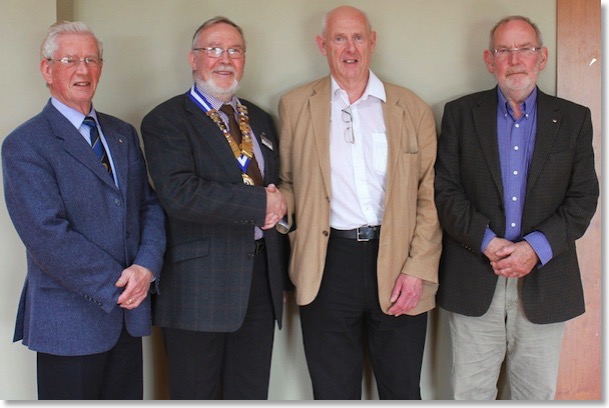
Photo: President Graham Kane greets Terry Moseley, with club members (L to R) Nigel Semple and John Dobson
Talk by Terry Moseley, who was ‘Reaching for the Stars’
Club President Graham Kane welcomed club members and guest Eric Fulton, to the meeting. The President then introduced our speaker for the morning Mr. Terry Moseley, who had us all 'Reaching for the stars'.
As the title of the talk indicates, the members were introduced to the world of Astronomy by a well known and long time employee of the Armagh Observatory. This was not a superficial introduction by any means, it was a detailed, entertaining and highly informative talk, which left the club secretary gasping for breath after 45 minutes and in a muddle with his 0s (zeros) trying to get the numbers right!
Terry began his talk by outlining the beginnings of Astronomy, which for all intents and purposes are now 'lost in the mists of time'. It is clear for world wide archaeological finds that we have been attempting to find out just what is happening in the sky for at least the last 4,000 years - What is an eclipse? What is a shooting star? Why does the Sun move across the sky? However, it is only in the last 100 years that we have found out more than simple observations of the Moon with a telescope. Our knowledge of our solar system and the universe beyond has increased dramatically, especially over the last 50 years and the advances in space flight.
For instance, today we know with certainty that our sun converts 4,000,000 tons of Helium into energy every second to sustain life on this planet. We also know a great deal about the other planets in our solar system, and Terry went on give vivid descriptions of these, their relative sizes, distances and what their surface conditions were like. From there he went beyond our own small part of the universe to show how small even our own Sun was compared to other known areas and galaxies.
Thanks to the Hubble Space Telescope, we can observe far out galaxies and get good images of systems some 60,000 light years away - and a light year (ly) isn't a measurement of 'time' but of 'distance', 1ly = 6,000,000,000,000 miles.
Terry then when on to pose and answer some of the common questions Astronomy seeks to find out more about. Questions like 'How many Stars are there?' - Stars are grouped into 'Galaxies', one galaxy equals around 100,000,000,000 Stars. Today we know there are at least 200,000,000,000 Galaxies (which means it's so big we, or least the Secretary, can't imagine just what that means in 'size' terms).
With the Hubble Telescope, astronomers have been able to 'look' at areas of space that had previously been thought 'empty', but now we can 'see' they are also crowded with Stars and Galaxies. We can now estimate the Universe is around 156,000,000,000,000,000 light years across and is expanding all the time!
So it's BIG, but how did the Universe begin? - The 'Big Bang' theory is about the best we have to date. This possibly happened around 13.8 thousand million years ago.
(Note: By now the Secretary was getting seriously concerned with the correct number of zeros in the numbers and effectively his mind shut down - numbers overload!)
Terry went on to speculate on 'Life' else ware in the Universe - because of the sheer numbers of planets and galaxies, there simply MUST be! So why don't they contact us? Or are we really trying hard enough to contact them? The answer isn't simply one of technology, we have the factor in the vast distances, the amount of time taken and inevitably costs involved. BUT if 'ET' or some relation of his were to land in Armagh and say to Terry 'take me to you leader' his answer would be 'I AM the leader!'
Such was the interest in the talk and its complexity, that things ran somewhat over time. So at the end of the talk there was only time for a very brief question and answer session (but it could have gone on a LOT longer). Just some of the topics covered were: 'So what we see isn't what IS it's what WAS?' - Yes, it could be 1,000s of years old. 'How do you count such big numbers?' - Take a small section then estimate up for vast numbers of other sections. And 'What about Religion?' - It's a matter of personal preference, and many references in the Bible can be seen as metaphors for what science claims.
Eventually the vote of thanks was proposed by Nigel Semple, who spoke for us all when he congratulated Terry on his interesting, amusing and enlightening talk. Which covered such a complicated subject and was given, and received, with such enthusiasm. The thanks were passed on by the President and the members showed their appreciation.
NOTE:
If members are interested to find out more (and doubtless, then correct these notes from the ‘zeros muddle’ I got in) then the old, but still available, BBC web site of P’atrick Moore’s The Sky at Night’ can be visited, just...
Talk by Terry Moseley, who was ‘Reaching for the Stars’
Club President Graham Kane welcomed club members and guest Eric Fulton, to the meeting. The President then introduced our speaker for the morning Mr. Terry Moseley, who had us all 'Reaching for the stars'.
As the title of the talk indicates, the members were introduced to the world of Astronomy by a well known and long time employee of the Armagh Observatory. This was not a superficial introduction by any means, it was a detailed, entertaining and highly informative talk, which left the club secretary gasping for breath after 45 minutes and in a muddle with his 0s (zeros) trying to get the numbers right!
Terry began his talk by outlining the beginnings of Astronomy, which for all intents and purposes are now 'lost in the mists of time'. It is clear for world wide archaeological finds that we have been attempting to find out just what is happening in the sky for at least the last 4,000 years - What is an eclipse? What is a shooting star? Why does the Sun move across the sky? However, it is only in the last 100 years that we have found out more than simple observations of the Moon with a telescope. Our knowledge of our solar system and the universe beyond has increased dramatically, especially over the last 50 years and the advances in space flight.
For instance, today we know with certainty that our sun converts 4,000,000 tons of Helium into energy every second to sustain life on this planet. We also know a great deal about the other planets in our solar system, and Terry went on give vivid descriptions of these, their relative sizes, distances and what their surface conditions were like. From there he went beyond our own small part of the universe to show how small even our own Sun was compared to other known areas and galaxies.
Thanks to the Hubble Space Telescope, we can observe far out galaxies and get good images of systems some 60,000 light years away - and a light year (ly) isn't a measurement of 'time' but of 'distance', 1ly = 6,000,000,000,000 miles.
Terry then when on to pose and answer some of the common questions Astronomy seeks to find out more about. Questions like 'How many Stars are there?' - Stars are grouped into 'Galaxies', one galaxy equals around 100,000,000,000 Stars. Today we know there are at least 200,000,000,000 Galaxies (which means it's so big we, or least the Secretary, can't imagine just what that means in 'size' terms).
With the Hubble Telescope, astronomers have been able to 'look' at areas of space that had previously been thought 'empty', but now we can 'see' they are also crowded with Stars and Galaxies. We can now estimate the Universe is around 156,000,000,000,000,000 light years across and is expanding all the time!
So it's BIG, but how did the Universe begin? - The 'Big Bang' theory is about the best we have to date. This possibly happened around 13.8 thousand million years ago.
(Note: By now the Secretary was getting seriously concerned with the correct number of zeros in the numbers and effectively his mind shut down - numbers overload!)
Terry went on to speculate on 'Life' else ware in the Universe - because of the sheer numbers of planets and galaxies, there simply MUST be! So why don't they contact us? Or are we really trying hard enough to contact them? The answer isn't simply one of technology, we have the factor in the vast distances, the amount of time taken and inevitably costs involved. BUT if 'ET' or some relation of his were to land in Armagh and say to Terry 'take me to you leader' his answer would be 'I AM the leader!'
Such was the interest in the talk and its complexity, that things ran somewhat over time. So at the end of the talk there was only time for a very brief question and answer session (but it could have gone on a LOT longer). Just some of the topics covered were: 'So what we see isn't what IS it's what WAS?' - Yes, it could be 1,000s of years old. 'How do you count such big numbers?' - Take a small section then estimate up for vast numbers of other sections. And 'What about Religion?' - It's a matter of personal preference, and many references in the Bible can be seen as metaphors for what science claims.
Eventually the vote of thanks was proposed by Nigel Semple, who spoke for us all when he congratulated Terry on his interesting, amusing and enlightening talk. Which covered such a complicated subject and was given, and received, with such enthusiasm. The thanks were passed on by the President and the members showed their appreciation.
NOTE:
If members are interested to find out more (and doubtless, then correct these notes from the ‘zeros muddle’ I got in) then the old, but still available, BBC web site of P’atrick Moore’s The Sky at Night’ can be visited, just...

Also, the current BBC programme that carries the same name (but is very different in it’s presentation from Sir Patrick) can be viewed, if you just...

Don’t forget, these links will open in new windows (or ‘Tabs’), so ‘Close’ these windows to return to your Probus pages.
(Secretary, Mike Turner)