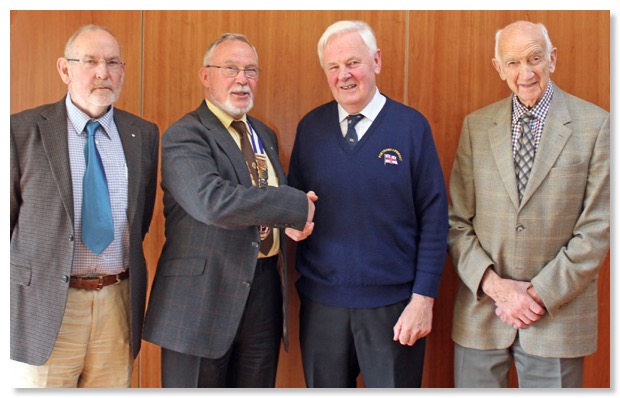
Speaker for Tuesday 8th October 2013 - Mr Fred Williams
Talk by Fred Williams on the ‘Royal National Lifeboat Institution’
Club President Graham Kane introduced our speaker for the morning, Mr. Fred Williams, who gave an informative talk, with an exciting video presentation about the Royal National Lifeboat Institution (RNLI). A copy of the video can be seen here (see link below), to view again if members are interested.
Fred began his talk with a short history of the RNLI. It was set-up by the visionary Sir William Hillary in 1825 - in the years up to now, it is estimated that more than 130,000 lives have been saved from the sea. It was very difficult for Hillary to get funding for the idea of a lifeboat service, but the 'Grace Darling incident' (*Click Me*) brought the idea into the public light, and donations soon started to come in, and the lifeboat network around the coast of GB and Ireland started to take shape. In the early days, all the boats were rowing boats, now they are highly powered and very manageable at sea.
Today there are 236 Lifeboat Stations and 344 boats (some stations, like Portrush, having two boats). On average the RNLI save 22 lives each day and are on call 24/7/365. But needless to say all this costs money! Every day the RNLI has to find around £450,000 just to keep it's lifeboat stations running. To train a member of a lifeboat crew costs about £1,200 and the 'kit' a crew member needs costs around another £1,200. True, the government does give some money - about 1% of the money needed, so 99% of funding has to come in from charitable giving (and THAT is where clubs like ours or individual members, can help!).
Fred then went on to show the very good, clear and somewhat exiting video to the members (*This video is currently unavailable-WebEd 2018).

To end the talk and presentation, Fred explained the sequence of events that are triggered by someone contacting the 999 emergency number, and the difference between the Coastguard Service and the RNLI. Fred also gave us a brief history of the Portrush lifeboat station, starting from its origins in 1890. The station has a local crew of 25 volunteers, of which 6 or 7 would man (or is that 'person'? - as there is one very good female crew member) the large boat and 2 or 3 the small (inshore) boat.
Fred then left a good time for questions, as he knew many of the members would want to ask, and get specific answers to queries they had. He was right! Just some of the questions (and answers) included: 'How long does it take to get a crew to the station?' - That depends on the day and time, sometimes in summer and gridlock around the harbour roads it can take 20 minutes. 'how about taking on crew?' - We get quite a lot of people enquiring, many drift off when then find they don't get paid. We normally have volunteers involved in basic training exercises only for the first few months as they really have to 'fit into the team' and be a part of the station. When everyone is happy, then we can arrange the full (expensive) training. 'Do the crew get seasick?' - Not aware of this happening, but as long as they can still do the job, it doesn't matter - and Fred doesn't ask! +Many more questions asked as you can guess!
A vote of thanks was proposed by Joe Alcorn, a lifelong sailor, who fortunately had never needed the help of the RNLI, but he was so thankful that they were there IF there ever was an emergency. A 'thank you' for a splendid talk, about a vital and bravely crewed service. The thanks were passed on by the President. The members showed their appreciation.
For more information about the Royal National Lifeboat Institution, click the RNLI Logo - it will open in a new window -

(Secretary, Mike Turner)