Speaker for Tuesday 23rd April 2013 - Edward Montgomery
25/04/13 18:39
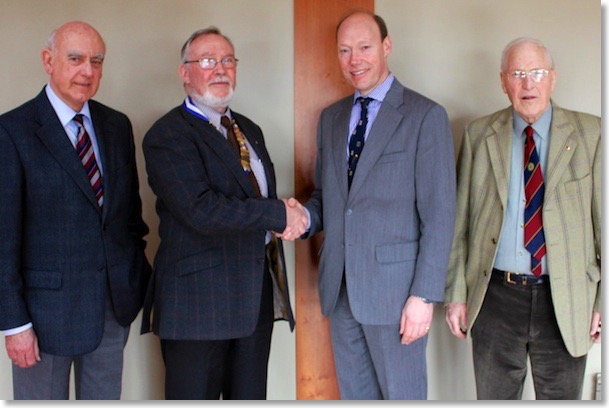
Photo: President Graham Kane greets Edward Montgomery, with club members (L to R) Jim Hillis and Cecil Leitch
Talk by Edward Montgomery on 'The Honorable The Irish Society'
Club President Graham Kane welcomed club members and guest Eric Fulton to the meeting. The President then introduced our speaker for the morning Edward Montgomery, who gave a talk about 'The Honorable The Irish Society' (IS).
Attached to these notes is a short booklet outlining the formation of the IS and it's current work. Web site: http://www.honourableirishsociety.org.uk (Note: this link will open in a new window. Close that window to return to this page)
Edward began his talk by saying that this was a very significant year for the IS, as in 2013 they are celebrating the 400th anniversary of their charter. He then went on to illustrate the talk with a fine 'PowerPoint' presentation, showing many historic images from four centuries of history.
Breaking the talk and presentation into century sections, Edward showed how the C17 maps of the North West of Ireland were divided into sections and allocated to different London livery companies for the 'Plantation' of Ulster. Deciding on Derry as the main base for the new settlers - and naming it 'Londonderry' - the companies started building the famous walls in 1613. The work was completed in 1618 at a cost of £10,700. The IS also funded the building of St Colum's in 1625 - 1633 at a cost of just £4000. Original plans for Coleraine showed a similar fortification to Derry, but this has long since been removed (or never completed?). The Plantation didn't go smoothly, especially between 1615 - 1635. The policy of 'crushing the native Irish' only led to more trouble. There were too few settlers, too large an area to look after, poor to non-existent communications and dishonest agents overseeing the plantation. The famous 'Siege of Londonderry' didn't help either.
By the C18 the IS was concentrating of the infrastructure of the area. It provided the first school in Coleraine in 1705 (and it still exists). The IS held the salmon rights in the area as well as timber rights too. It also benefitted from the Church lands and the allocations for corporations.
Improvements in the C19 started to make their mark in the IS management. There were regular visits from London after 1814 and not just leaving affairs to agents. Communications improved and there was more control over leases. The 'Victorian Era' saw the beginning of a larger building programme and a philanthropic ideal to the IS involvement. Significant properties constructed include the Londonderry Guild Hall (due to be re-opened after refurbishment in June 2013) and the town hall in the Diamond, Coleraine.
In the C20, the 'Land Acts' (began in late C19) deprived the livery companies of estates, so they withdrew from Ireland and the IS income was severely affected. In 1974 the IS established a 'Local Advisory Committee', which provided more local involvement in local decisions. In 1990 the IS moved its offices from Londonderry to 'Cutts House' in Coleraine. This being situated on the Bann was especially helpful for the control of fishing rights - poaching is one of the major problems the Society faces.
Today in the C21 the IS has a diverse and extensive charity function in our area. In 2013 they are involved with establishing a new high speed digital network to assist new businesses, plant Oak Trees, fund history lectures, encourage primary schools and Church services. Most importantly, there is a programme of modernisation for the IS itself, in order for it to become more suited for today's world.
At the end of the talk there was only time for a very brief question and answer session. Ken Parkes asked Edward to give his views on the Derry - Londonderry name debate. Edward said that clearly this was a complicated issue and requires a lot of time to fully discuss. However, the basics are that the city council are entitled to change their name whenever they want - and did around 1998 (?) - so Derry City Council is quite acceptable. The actual name of the City is more difficult as the charter calls it 'Londonderry' and so legally this has to stay until there is an agreement were it can legally be changed.
The vote of thanks was proposed by Cecil Leitch, whom claiming to be 'unaccustomed to public speaking', thought that it was something of a shame that such an interesting, enjoyable and informative talk should have to end. He most heartily proposed a sincere vote of thanks on behalf of the members, and the thanks were duly passed on by the President.
PS:- The original title of the society was - The Society of the Governor and Assistants, London, of the New Plantation in Ulster, within the Realm of Ireland - hardly a 'snappy' title!
Talk by Edward Montgomery on 'The Honorable The Irish Society'
Club President Graham Kane welcomed club members and guest Eric Fulton to the meeting. The President then introduced our speaker for the morning Edward Montgomery, who gave a talk about 'The Honorable The Irish Society' (IS).
Attached to these notes is a short booklet outlining the formation of the IS and it's current work. Web site: http://www.honourableirishsociety.org.uk (Note: this link will open in a new window. Close that window to return to this page)
Edward began his talk by saying that this was a very significant year for the IS, as in 2013 they are celebrating the 400th anniversary of their charter. He then went on to illustrate the talk with a fine 'PowerPoint' presentation, showing many historic images from four centuries of history.
Breaking the talk and presentation into century sections, Edward showed how the C17 maps of the North West of Ireland were divided into sections and allocated to different London livery companies for the 'Plantation' of Ulster. Deciding on Derry as the main base for the new settlers - and naming it 'Londonderry' - the companies started building the famous walls in 1613. The work was completed in 1618 at a cost of £10,700. The IS also funded the building of St Colum's in 1625 - 1633 at a cost of just £4000. Original plans for Coleraine showed a similar fortification to Derry, but this has long since been removed (or never completed?). The Plantation didn't go smoothly, especially between 1615 - 1635. The policy of 'crushing the native Irish' only led to more trouble. There were too few settlers, too large an area to look after, poor to non-existent communications and dishonest agents overseeing the plantation. The famous 'Siege of Londonderry' didn't help either.
By the C18 the IS was concentrating of the infrastructure of the area. It provided the first school in Coleraine in 1705 (and it still exists). The IS held the salmon rights in the area as well as timber rights too. It also benefitted from the Church lands and the allocations for corporations.
Improvements in the C19 started to make their mark in the IS management. There were regular visits from London after 1814 and not just leaving affairs to agents. Communications improved and there was more control over leases. The 'Victorian Era' saw the beginning of a larger building programme and a philanthropic ideal to the IS involvement. Significant properties constructed include the Londonderry Guild Hall (due to be re-opened after refurbishment in June 2013) and the town hall in the Diamond, Coleraine.
In the C20, the 'Land Acts' (began in late C19) deprived the livery companies of estates, so they withdrew from Ireland and the IS income was severely affected. In 1974 the IS established a 'Local Advisory Committee', which provided more local involvement in local decisions. In 1990 the IS moved its offices from Londonderry to 'Cutts House' in Coleraine. This being situated on the Bann was especially helpful for the control of fishing rights - poaching is one of the major problems the Society faces.
Today in the C21 the IS has a diverse and extensive charity function in our area. In 2013 they are involved with establishing a new high speed digital network to assist new businesses, plant Oak Trees, fund history lectures, encourage primary schools and Church services. Most importantly, there is a programme of modernisation for the IS itself, in order for it to become more suited for today's world.
At the end of the talk there was only time for a very brief question and answer session. Ken Parkes asked Edward to give his views on the Derry - Londonderry name debate. Edward said that clearly this was a complicated issue and requires a lot of time to fully discuss. However, the basics are that the city council are entitled to change their name whenever they want - and did around 1998 (?) - so Derry City Council is quite acceptable. The actual name of the City is more difficult as the charter calls it 'Londonderry' and so legally this has to stay until there is an agreement were it can legally be changed.
The vote of thanks was proposed by Cecil Leitch, whom claiming to be 'unaccustomed to public speaking', thought that it was something of a shame that such an interesting, enjoyable and informative talk should have to end. He most heartily proposed a sincere vote of thanks on behalf of the members, and the thanks were duly passed on by the President.
PS:- The original title of the society was - The Society of the Governor and Assistants, London, of the New Plantation in Ulster, within the Realm of Ireland - hardly a 'snappy' title!
(Secretary, Mike Turner)