Speaker for Tuesday 15th October 2013 - Mr David Archer
Talk by David Archer on Africa - ‘A Venture into the Interior’
Club President Graham Kane welcomed club members and then introduced our speaker for the morning and brother of member Jim, Mr. David Archer, who was making a most welcome return to the club to talk about Africa and part of its history.
David began his talk by reminding members that this was his third visit to the club, having first talked about Afghanistan, then Labrador and now about his seven years Africa (taken in various stints between 1967 and 1986). The aim of the talk would be to give a bit of the historical background to the 'discovery' and 'development' of that continent, and illustrate it with some of the photos he had taken over the years - in what proved to be an excellent PowerPoint presentation, and can be viewed by ‘clicking’ the link below:-
The talk was divided into several sections, beginning with "The mystery on the source of the Nile". David gave a fascinating historical overview of the attempts to trace the source and of the early maps of the region - mostly they were blank. The big problem for the explorers was the massive swampy, marshy like area called the 'Nile Sudd' - there is no simple single river to just follow to it's end!
David then went on to tell us about the travels of David Livingstone, over the many years Livingston had lived (and finally died) in the area. For more information on David Livingstone, see below. This part of the talk was illustrated by some very lovely pictures taken by David for his time the area. David said that it can be argued that although Livingstone was ultimately unsuccessful - he never found the source of the Nile, and only managed to convert one person in all his years there, he did 'open up' the continent, remap vast areas and left a mark that survives today.
It was then on to a look at the 'Mountains of Africa', again starting with a historical perspective - snow was reported to be seen on Kilimanjaro in 1848, but not believed as it was thought to be too hot there! David then went on to illustrate some of the unique vegetation of the mountain area and also show some pictures of his climb up Mt. Kilimanjaro in 1969.
The final part of the talk was (almost) retracing of the steps of Laurence Van der Post in the Nyika Plateau, that David made in 1975 what working there as a hydrologist (?). Again we were treated to some fine photographs of the local Phoka people and where they lived.
The talk ended with an all to brief Question and Answer session, much to the interest and enjoyment of the members. Questions included - 'What about the effects of Climate Change on the area?' - This is effecting the environment, but NOT the snow loss on Kilimanjaro, which is due to less rainfall not temperature. 'What was the political situation like?' - There was no problem then in Zambia and although Malawi was undergoing some upheaval, we were never fearful and local people were always friendly and very honest. 'What effects did the slave trade have?' - Mainly being in the East of Africa, it was the Arab slavers that took the people to further East, estimated at around 100,000 a year for many years. But what happened to them? Did they all die? If you look at Western routed slavery, you can see the impact on the streets of America, and other countries in the West, but not in the East! - (now there is a subject to ponder over! And volunteers to do some research? - Web Ed)
A vote of thanks was proposed by Hamilton Houston for David's interesting, informative and so well delivered talk. This was passed on by the President. The members showed their appreciation.
(Secretary, Mike Turner)
----- o O o -----
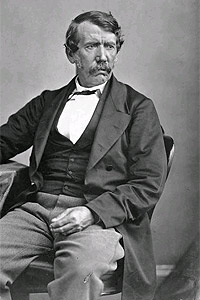
For more information about Livingstone, follow this link:-
http://en.wikipedia.org/wiki/David_Livingstone
David Livingstone
From Wikipedia, the free Encyclopaedia
David Livingstone (19 March 1813 – 1 May 1873) was a Scottish Congregationalist pioneer medical missionary with the London Missionary Society and an explorer in Africa. His meeting with H. M. Stanley on 10 November 1871 gave rise to the popular quotation "Dr. Livingstone, I presume?"
Perhaps one of the most popular national heroes of the late 19th century in Victorian Britain, Livingstone had a mythic status, which operated on a number of interconnected levels: Protestant missionary martyr, working-class "rags to riches" inspirational story, scientific investigator and explorer, imperial reformer, anti-slavery crusader, and advocate of commercial empire.
His fame as an explorer helped drive forward the obsession with discovering the sources of the River Nile that formed the culmination of the classic period of European geographical discovery and colonial penetration of the African continent. At the same time his missionary travels, "disappearance" and death in Africa, and subsequent glorification as posthumous national hero in 1874 led to the founding of several major central African Christian missionary initiatives carried forward in the era of the European "Scramble for Africa".